|
|
|
|
this page had been taked from net.tutor Making sense out of all your research options is like solving a complicated
puzzle. It helps to have a strategy (or plan) when you approach a puzzle.
Approaching research with a strategy can also save time and help you to be more
effective.
To begin, think about the kind of information needed for your research
project. This depends on:
Are you writing a research paper on an unfamiliar topic? You may need some
background first to help you understand important concepts and people connected
to your topic before you can go further.
If you are looking for evidence to support an argument, you will want to find
analytical or data sources. Perhaps you need just a few very current news
stories or some reviews of a book, movie or product.
In any case, thinking first about what kind of information you need will help
you with the first step of your research strategy -- deciding what types
of information sources to use in order to get quickly the kind of
information you need.
The following paragraphs discuss types of information sources in more detail
and provide some online library and Web examples.
[NOTE: You must be affiliated with OSU or another OhioLINK school to connect
to most of the online library sources used as examples in this tutorial. And if
you use a commercial service provider, like AOL, to connect to the Internet, you
must also set up your browser in a special way. Follow the Help link at the top
of this page for more information.]
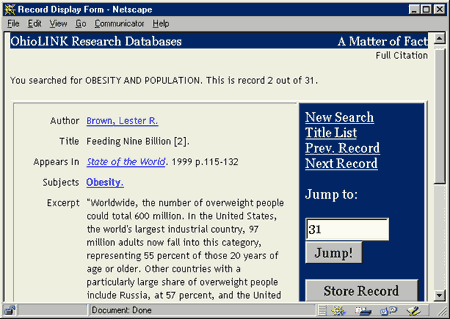
Background information sources offer overviews of topics, people, places,
events. Encyclopedias, dictionaries and other reference works as
well as Web sites can all provide background information.
Here are some online library sources that provide useful background
information:
The Web is like a huge encyclopedia, but it's more difficult to find the
information you need quickly on the Web. The Web is an especially good source
for background information on businesses and organizations of all kinds.
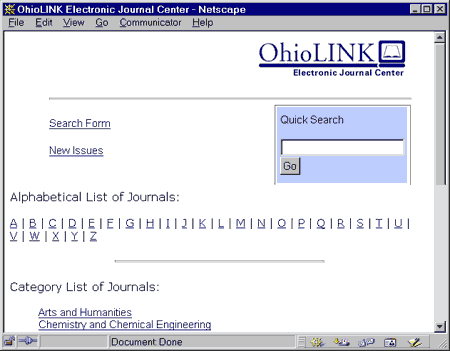
Books, journal articles and reports all provide
scholarly examinations of topics in-depth. Many excellent online library sources
are available to help you find this kind of information.
For example:
 While the Web is not the first choice for finding scholarly analysis, many useful government and technical reports are available on the Web.
1D: Sources for News and OpinionYou can find news stories and opinion pieces (editorials, commentary or reviews) in newspapers and popular magazines as well as a wide variety of Web sites and Web news services. Some online library sources include:
The Web is an especially strong resource for keeping up with breaking news and finding alternative viewpoints.
1E: Sources for Facts and StatisticsFacts and statistical data are published in encyclopedias, handbooks, government publications, and in articles. Some online library resources for factual information are:
The Web is also an excellent resource for facts and data. Use:
1F: Sources for MultimediaMultimedia sources include images, animations, video and sounds. Some online library resources for locating multimedia include:
The Web is a great source for finding multimedia:
|
Egyptian Office www.mertic.8k.com
Created and Design By Mohamed H. El-Mahdy mahdycom@yahoo.com
|